Let Automation Do the Boring Part: InDesign, AI, and Smarter Workflows
Max Dunn
San Francisco, California
Olav Martin Kvern
Seattle, Washington
Virtual
Thursday, October 15, 2026
3:30–4:00 p.m. Pacific — Networking
4:00–5:45 p.m. Pacific — Presentation
InDesign can do far more of your repetitive work than you may realize. In this session, Max Dunn and Olav Martin Kvern show how designers can use automation to speed up production without surrendering control of the creative process. They'll cover everything from simple timesavers you can start using today to more advanced automation, third-party tools, and AI-assisted workflows.
Along the way, Max and Olav will explain when AI makes sense, when predictable, deterministic automation is the better tool, and what makes InDesign so unusually extensible. They'll close with a beginner's introduction to running scripts, including the ones already built into InDesign and a set of free scripts for attendees. No scripting experience required: if you can use InDesign, you can leave this session automating it.
Free Drawing
All attendees are eligible to participate in a free drawing. No purchase or donation is required. However, you must attend the presentation to be eligible. Prizes delivered electronically are available to anyone in the world. Physical prizes are available to anyone in the U.S. without a shipping charge. Winners from outside the U.S. who choose a physical prize must bear the cost of shipping.
About the Presenters

Max Dunn
Max Dunn grew up in Berkeley, California, earned a BA in Music from Wesleyan University in 1985, and spent the 1990s as a database programmer in Silicon Valley before directing Software Engineering at Bertelsmann Industry Services (BIS) at the peak of the dot-com era. BIS was then feeding billions of pages a year to Bertelsmann's 300 print subsidiaries worldwide, and it was there that Max fell in love with document and image automation. He immersed himself in the emerging XML standard and its relatives (XSLT, XSL-FO, SVG), while BIS pioneered online document creation and became the first company to produce dynamic PDF from web input.
In 2000, Max co-founded Silicon Publishing with BIS colleague Alissa Whitney; Adobe became their first client on day one. SPI helped Adobe bring XML support and server capabilities to FrameMaker and led DITA implementation for years, but the founders' real passion was Adobe's new InDesign, which they pushed to its limits on the desktop while lobbying Adobe for a server version. When InDesign Server finally shipped in 2005, SPI grew substantially. The company later hired numerous members of the original InDesign team, and in 2011 Olav Martin Kvern, who had led InDesign automation at Adobe, joined SPI. Along the way, Max tech-edited SVG Unleashed, contributed a chapter to Charles Goldfarb's XML Handbook, authored whitepapers for Adobe, published articles on XML, InDesign Server, and DITA, and has spoken at numerous conferences and on technology and business podcasts.
Max and Alissa continue to lead SPI as CEO and CTO, and the company has delivered some of the largest document automation projects in the world for leading brands. Max is a strong believer in staying current: SPI's code is continually updated to reflect test-driven development, continuous integration, and prudent adoption of technologies such as XR, AI, and headless, API-first publishing. Today he is energized by the renaissance in Adobe's graphic and document software. Offerings like Adobe Express and Firefly Services closely parallel SPI's long-held devotion to online editing and server-side rendering, crystallizing the vision Max has pursued since the beginning, and SPI is more deeply allied with Adobe than ever.
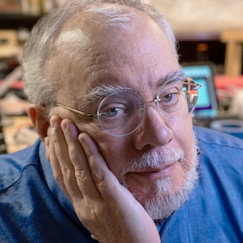
Olav Martin Kvern
Olav Martin Kvern has spent his career at the intersection of graphic design and automation, starting in the 1970s as a scientific illustrator (veterinary, archaeological) before moving to Seattle to work in illustration, design, and typesetting. Early on, he began writing code to automate his own production work, first on a Compugraphic typesetter and then on an Interleaf system, where he programmed in BASIC and Interpress, a precursor of PostScript. That instinct, using code to take the drudgery out of publishing, has defined everything since.
In 1987 he joined Aldus, where he moved from documentation into PageMaker engineering, helped design PageMaker's Control panel, and championed its scripting support. He co-wrote Real World PageMaker and Real World FreeHand, and his long-running "Desktop Science" column in Aldus Magazine and later Adobe Magazine taught a generation of designers to automate their work with AppleScript, PostScript, and Visual Basic. He went on to program the intelligence behind Visio's SmartShapes as the company's "ShapeMaster," served as an art director at Peachpit Press, and founded a plug-in development company, Desktop Science, that built tools for Extensis and Wizards of the Coast.
Kvern joined Adobe in 1999 to lead InDesign scripting documentation and evangelism, and left a lasting mark on the product: he originated the ideas for both IDML and InDesign Server, built the forum that became the hub of the InDesign automation community, and wrote Real World InDesign, later collaborating with David Blatner on subsequent editions. His guiding principle is that scripting belongs to every designer, not just programmers, because it frees creative people from repetitive work. Since 2011 he has been at Silicon Publishing, contributing to nearly every product release, including a system that round-trips InDesign typesetting to HTML5 and back in Silicon Designer.